Delivery Status Notification.

Hi there!

I regret to inform you about some sad news for you.
Approximately a month or two ago I have succeeded to gain a total access to all your devices utilized for browsing internet.
Moving forward, I have started observing your internet activities on continuous basis.

Go ahead and take a look at the sequence of events provided below for your reference:
Initially I bought an exclusive access from hackers to a long list of email accounts (in today’s world, that is really a common thing, which can arranged via internet).
Evidently, it wasn’t hard for me to proceed with logging in your email account ().

Within the same week, I moved on with installing a Trojan virus in Operating Systems for all devices that you use to login to email.
Frankly speaking, it wasn’t a challenging task for me at all (since you were kind enough to click some of the links in your inbox emails before). Yeah, geniuses are among us.

Because of this Trojan I am able to gain access to entire set of controllers in devices (e.g., your video camera, keyboard, microphone and others).
As result, I effortlessly downloaded all data, as well as photos, web browsing history and other types of data to my servers.
Moreover, I have access to all social networks accounts that you regularly use, including emails, including chat history, messengers, contacts list etc.
My unique virus is incessantly refreshing its signatures (due to control by a driver), and hence remains undetected by any type of antiviruses.

Hence, I guess by now you can already see the reason why I always remained undetected until this very letter…

During the process of compilation of all the materials associated with you,
I also noticed that you are a huge supporter and regular user of websites hosting nasty adult content.
Turns out to be, you really love visiting porn websites, as well as watching exciting videos and enduring unforgettable pleasures.
As a matter of fact, I was not able to withstand the temptation, but to record certain nasty solo action with you in main role, and later produced a few videos exposing your masturbation and cumming scenes.

If until now you don’t believe me, all I need is one-two mouse clicks to make all those videos with everyone you know, including your friends, colleagues, relatives and others.
Moreover, I am able to upload all that video content online for everyone to see.
I sincerely think, you certainly would not wish such incidents to take place, in view of the lustful things demonstrated in your commonly watched videos,
(you absolutely know what I mean by that) it will cause a huge adversity for you.

There is still a solution to this matter, and here is what you need to do:
You make a transaction of $1490 USD to my account (an equivalent in bitcoins, which recorded depending on the exchange rate at the date of funds transfer),
hence upon receiving the transfer, I will immediately get rid of all those lustful videos without delay. After that we can make it look like there was nothing happening beforehand.
Additionally, I can confirm that all the Trojan software is going to be disabled and erased from all devices that you use. You have nothing to worry about, because I keep my word at all times.

That is indeed a beneficial bargain that comes with a relatively reduced price,
taking into consideration that your profile and traffic were under close monitoring during a long time frame.
If you are still unclear regarding how to buy and perform transactions with bitcoins – everything is available online.

Below is my bitcoin wallet for your further reference: bc1qnpsqf3xsr6a2udwjkry6pk778y739k6spvje97

All you have is 48 hours and the countdown begins once this email is opened (in other words 2 days).

The following list includes things you should remember and avoid doing:
> There’s no point to try replying my email (since this email and return address were created inside your inbox).
> There’s no point in calling police or any other types of security services either. Furthermore, don’t you dare sharing this info with any of your friends.
If I discover that (taking into consideration my skills, it will be really simple, because I control all your systems and continuously monitor them) – your nasty clip will be shared with public straight away.
> There’s no point in looking for me too – it won’t result in any success. Transactions with cryptocurrency are completely anonymous and untraceable.
> There’s no point in reinstalling your OS on devices or trying to throw them away. That won’t solve the issue,
since all clips with you as main character are already uploaded on remote servers.

Things that may be concerning you:
> That funds transfer won’t be delivered to me.
Breathe out, I can track down everything right away, so once funds transfer is finished,
I will know for sure, since I interminably track down all activities done by you (my Trojan virus controls all processes remotely, just as TeamViewer).
> That your videos will be distributed, even though you have completed money transfer to my wallet.
Trust me, it is worthless for me to still bother you after money transfer is successful. Moreover, if that was ever part of my plan, I would do make it happen way earlier!

We are going to approach and deal with it in a clear manner!

In conclusion, I’d like to recommend one more thing… after this you need to make certain you don’t get involved in similar kind of unpleasant events anymore!
My recommendation – ensure all your passwords are replaced with new ones on a regular basis.

citsci-discussion-l Invitation 6/3 – An Insiders View on the Citizens Assembly on Climate in France

Can a citizens’ convention change the world?
The answer is yes! The Citizens’ Convention for Climate in France proved it.

This morning on June 29, French President Emmanuel Macron announced strong measures in response to the Citizens’ Convention for Climate. He announced that he was accepting all the proposals handed to him by the panel of randomly selected citizens “with the exception of three of them” which are recommended for a referendum. He vowed to place ecology at the heart of the countries’ production system as well as to invest €15 billion dedicated to ecological transformation. By doing so, he acknowledges the legitimacy of deliberative participation and encourages its implementation into French law.

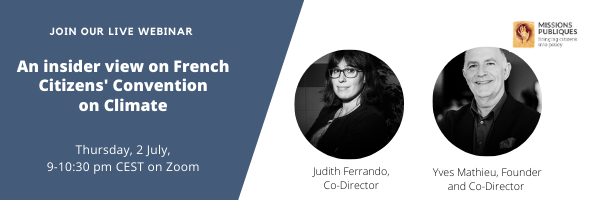
As co-organizers of this unique experience, Missions Publiques invites you to attend a webinar to gain fresh and direct insight into the Citizens’ Convention.

Yves Mathieu, and Judith Ferrando, as Co-Directors of Missions Publiques, both deeply involved in the Convention, will provide you with key learnings of the assembly from its launch in 2019 to their invitation to the Elysée Palace. They will describe, explain, and illustrate how this far-reaching process will change society in depth.

You will learn how citizens worked together to formulate proposals, what the outcomes are and why this experience could serve as a democratic reference abroad. This will be exclusive insight into France’s first successful national citizens’ assembly for climate.

To know how we make democracy happen, join us on Thursday, July 2, 3-4:30 PM US ET

Zoom: https://missionspubliques.zoom.us/meeting/register/tZAqcOGhrTkjGd3oTtmmX4L-joLjHr1VUTgh

You will hear from:

  • Yves Mathieu (Co-Director and Co-Founder)
  • Judith Ferrando (Co-Director)

If you wish to read the final propositions of the Citizens’ Convention on Climate, please read here at Democracy International:

http://democracy-international.org/final-propositions-french-citizens-convention-climate

Book your spot now by registering online!

Missions Publiques team: https://missionspubliques.org/?lang=en

citsci-discussion-l New Publication Opportunity! CS Methods and Data

Begin forwarded message:

From: Anne Bowser <anne.bowser>

Subject: [citsci-discussion-l] New Publication Opportunity! CS Methods and Data

Date: April 28, 2020 at 11:04:06 AM EDT

To: CitSci-discussion-L, Alex de Sherbinin <adesherbinin>, Sven Schade <s.schade>

Reply-To: Anne Bowser <anne.bowser>

Greetings!

We are excited to announce a new publication opportunity– a Research Topic on Citizen Science Data and Methods published with the leading open access journal Frontiers.

About this Research Topic (code for “Special Issue”)
This Research Topic publishes comprehensive, peer-reviewed information on citizen science methods and data sets.

In citizen science, members of the public contribute to authentic scientific research to meet real-world goals. Citizen science is a perspective, or a way of doing research, that crosses scientific disciplines ranging from astronomy to biology, to public health, and also the social and behavioral sciences. Citizen science initiatives are run by researchers in academic institutions, government agencies, non-profits, community-based groups, and individuals. With its rich portfolio of activities, citizen science helps in creating valuable scientific data sets in multiple ways.

This is a Research Topic for citizen science researchers, practitioners, and volunteers to publish their data. For the purpose of this Research Topic, a data set is defined as a collection of similar data, sharing a structure, which covers a fixed period of time. The mission of this Research Topic is to advance citizen science and broader open science agendas by making data more findable, better documented, and ultimately reusable. The collection will accomplish this mission by inviting authors to submit information about their data set, including information about data collection methodologies relevant to data quality assurance and data quality control (QA/QC) practices; facilitating a peer-review process; publishing reviewed submissions along with the outcomes of peer review; and, assigning each publication a Digital Object Identifier (DOI).

This collection is open to the following two article types:

  • Methods: submissions describing the data collection process, QA/QC management plan, and similar strategies used for producing data that is fit for use in research or policy.
  • Data Report: providing detailed information about an already collected citizen science data set and documenting the data set to facilitate re-use by other research and policy initiatives.

During the submission process, authors will submit their data collection Methods or Data Report through the Frontiers platform. In addition, authors who submit data reports must complete a short form to collect additional information including metadata and a URI pointing to the location of their data in an open repository.* Data sets that are not hosted in an open repository cannot be reviewed at this time. Please follow this link to access our template for the supplementary information for data sets.

The Editorial Boards of the affiliated journals for this Research Topic acknowledge and represent three types of expertise: knowledge of the field of citizen science (including effective practices related to data collection, sharing, and use), knowledge of key constructs related to data and information management (including data quality and interoperability), and knowledge of different scientific research domains. Each submission will be evaluated by at least one reviewer with knowledge on citizen science or data and information, and one reviewer with knowledge of the relevant scientific research domains.

This Research Topic, Open Citizen Science Data and Methods, was launched on the 50th anniversary of Earth Day, in alignment with Earth Challenge 2020. One priority of this collection will be to showcase datasets related to the six Earth Challenge 2020 research areas:
(1) air quality
(2) water quality
(3) insect populations
(4) plastics pollution
(5) food security
(6) climate change.

This Research Topic takes the perspective that the analysis and discussion of research conducted through citizen science methodologies should be published in appropriate disciplinary journals. In addition, research on how to conduct citizen science, or “the science of citizen science,” should be published in journals such as Citizen Science: Theory and Practice.

Additional Information on Publication Costs
Frontiers is an open access publisher with a commitment to open science. Many institutions have agreements with Frontiers around publication costs. In addition, to promote the publication of citizen science data and methods representing a wide range of perspectives, the journal has agreed to waive a handful of publication fees when such fees are prohibitive to publishing.

We hope to see a number of contributions from the folks on this discussion list. Please visit the Frontiers website to register your interest to submit an abstract. If you have questions, feel free to reach out individually, and we’ll do our best to answer them.

Best wishes,

Anne Bowser, Research Topic Editor
Sven Schade, Research Topic Editor
Alex de Sherbinin, Research Topic Editor

*If finding a place to store your data is an issue, email anne.bowser, and we’ll try to help!

New paper: key traits of Volunteer Monitoring Programs as related to Outcomes

From: Kris Stepenuck <kstepenu>

Subject: [citsci-discussion-l] New paper: key traits of VM programs as related to outcomes

Date: January 7, 2019 at 12:10:36 PM EST

To: “citsci-discussion-l” <citsci-discussion-l>

Reply-To: Kris Stepenuck <kstepenu>

Greetings citizen science community,

I wanted to share a recently released paper that identifies seven key traits of volunteer water monitoring programs as related to outcomes on natural resource policy and management. I hope it will be useful to volunteer monitoring and other citizen science programs as they grow and develop.

Here is a link to the full paper in Society & Natural Resources followed by the abstract:
https://www.tandfonline.com/doi/pdf/10.1080/08941920.2018.1511022?needAccess=true

Abstract:
As citizens take on expanded roles in gathering and reporting environmental data, their potential impact may relate to organizational traits. This study sought to understand the relationship through a survey that identified traits and impacts of U.S. volunteer water monitoring programs on natural resource policy and management. A multiple regression model tested the influence of nine traits on an index of impact, addressing eight a priori hypotheses related to natural resource management outcomes. Seven traits were significantly related to impacts. Significant positive relationships included: the objective to address an environmental crisis; an EPA and/or state approved quality assurance plan; support of external decision makers who may use or benefit from data; larger budget; volunteers playing more roles in the research process. Fewer impacts were expected from programs operating within schools. Understanding these relationships can help guide citizen science programs or other types of citizen engagement efforts.

Kris Stepenuck
—-
Kristine Stepenuck, Ph.D.
University of Vermont
Extension Leader, Lake Champlain Sea Grant
Extension Assistant Professor of Watershed Science, Policy and Education, Rubenstein School of Environment and Natural Resources
81 Carrigan Dr, #312F
Burlington, VT 05405
Phone: (802) 656-8504
Email: kris.stepenuck

PICISOC Tech In Pacific website on startups and new technology

Another Pacific Islands INNOVATION that might be useful in the Caribbean, if it’s not already being done… might want to build a Caribbean small island site that’s linked with the Pacific AND relevant global sites — especially GIN <https://www.globalislands.net/>, which is THE BEST source for news stories about small islands.

Bruce

Begin forwarded message:

From: Kenneth Katafono <kenneth.katafono>

Subject: [PICISOC] Tech In Pacific website on startups and new technology

Date: October 29, 2018 at 6:16:45 AM EDT

To: Pacific Islands Chapter of the Internet Society Discussion List <picisoc>

Reply-To: Pacific Islands Chapter of the Internet Society Discussion List <picisoc>

Just wanted to share this – http://www.techinpacific.com/

Met a guy from Startup&Angels (http://www.startupandangels.com/) based out of Sydney and we’re looking at hosting events/training in Suva next year to help boost our startup ecosystem in Fiji.

University of the Bahamas: Small Island Sustainability Research Complex

from Eye Witness News <https://ewnews.com/ub-opens-first-small-island-sustainability-research-complex>

UB opens first Small Island Sustainability Research complex

The University of The Bahamas (UB) recently opened its first, state-of-the-art science research facility, the G.T.R. Campbell Small Island Sustainability Research Complex, which, represents a significant move towards sustainability and the fulfilment of the United Nation’s Sustainable Development Goals.

The multi-million-dollar facility is the result of a gift to the University from the Freedom Foundation, and is named in honour of shipping magnate and naval architect the late George T. R. Campbell whose family was present to witness the milestone. Mr. Campbell founded Dockendale Shipping in Nassau, an operation now headed by H.E. Lowell Mortimer.

A LEED-certified complex with modern laboratories to support a wide-range of environmental monitoring and chemical analysis methods and techniques of the air, land and sea, the research centre is also dedicated to meeting national priorities in agricultural production as well as food safety and security.

H.E. Lowell Mortimer, one of the visionaries behind the newly constructed facility, has remained committed to the institution over the years. Given the intricacies of the design and construction of this building, it was years in the making.

“Around 2008, starting with Dr. Keva Bethel, followed by Janyne Hodder, a presentation was made to me for a sustainability centre and here we are today with the G.T.R. Campbell Small Island Sustainability Research Complex”, he shared.

He was pleased to see Mr. Campbell’s dream become a reality. “I hope that through this centre, it will help fulfil one of the visions of George Campbell in helping The Bahamas to feed itself, just as in Canada, he helped Canadians to feed themselves.”

UB President, Dr. Rodney D. Smith touted the collaboration that will exist as a result of this new paradigm. “Small Island Sustainability is a signature programme at UB with various degree options that will provide students the opportunity to interact with each other and create inter-disciplinary synergies for dynamic research,” he explained.

The building comprises three classrooms and a geographic information systems (GIS) teaching lab; 6 research labs, including 1 aseptic tissue culture lab (a sterile lab); 11 staff and research offices, and office spaces for visiting researchers, graduate students and laboratory technicians. Additionally, there are six active research laboratories which will focus, specifically, on Plant Tissue and Bio-technology, Geospatial Visualization and Informatics, Food and Natural Products Innovation, Plant, Soil, and Water Sciences, Applied Laser and Optical Science Research and Chemical and Environmental Analysis.

Minister of the Environment and Housing, Romauld Ferreira, a UB alumnus, underscored the importance of this new complex and the role it will play in the future growth and development of the country. He commended the university for being at the forefront of sustainability practices in the country.

“As we open the door to the GTR Campbell Small Island Sustainability Research Complex, we are opening the doors to the solutions to our nation’s burgeoning problems. We are equipping this generation and those to come, with the tools to address climate change and to create the future they want and deserve,” he said.

He also acknowledged Campbell’s legacy. “The Small Island Sustainability Research Complex will set the bar for environmental studies and research throughout The Bahamas while paying respect to a man with an honourable history as a naval architect and prominent global leader within the shipping industry.”

Naomi Campbell, daughter of the late George Campbell, reminisced about her father and spoke fondly of him “My father was in inventor. He was a thinker. He was curious. There is nothing he was not curious about…his mind never stopped working.”

Campbell also reflected on the significance of the complex and what it represents to The Bahamas and globally.

“Sustainability is the word going forward that will lead us into the future. The new generation of students that will graduate from this university will leave their imprint for following generations. We are initiating a process that is spawning itself across the world right now and throughout universities and it is a wonderful thing to be part of,” she said.

The GTR Campbell Small Island Sustainability Research Complex will further position the institution to attract and retain world-class faculty; enliven the University system and bring together students, experts and facilities to revolutionize teaching, research and studies in small island sustainability.

New Nature article: ‘No PhDs needed: how citizen science is transforming research”

from Nature <https://www.nature.com/articles/d41586-018-07106-5?utm_source=twt_nnc&utm_medium=social&utm_campaign=naturenews&sf200613030=1>

23 October 2018
No PhDs needed: how citizen science is transforming research
Projects that recruit the public are getting more ambitious and diverse, but the field faces some growing pains.
by Aisling Irwin

Filip Meysman knew he had made his mark on Antwerp when he overheard commuters discussing his research project on the train. Then, just a few days later, he saw an advertisement about his work on television. There it was, he says, “in between the toothpaste and George Clooney’s Nespresso”.

As a biogeochemist at the University of Antwerp in Belgium, Meysman wasn’t used to drawing so much attention. But that was before he adopted the citizens of northern Belgium as research partners. With the help of the Flemish environmental protection agency and a regional newspaper, Meysman and a team of non-academics attracted more than 50,000 people to CurieuzeNeuzen, an effort to assess the region’s air quality (the name is a play on Antwerp dialect for ‘nosy’ people).

The project ultimately distributed air-pollution samplers to 20,000 participants, who took readings for a month (see ‘Street science’). More than 99% of the sensors were returned to Meysman’s laboratory for analysis, yielding a bounty of 17,800 data points. They provided Meysman and his colleagues with information about nitrogen dioxide concentrations at ‘nose height’ — a level of the atmosphere that can’t be discerned by satellite and would be prohibitively expensive for scientists to measure on their own. “It has given us a data set which it is not possible to get by other means,” says Meysman, who models air quality.

Citizen science — active public involvement in scientific research — is growing bigger, more ambitious and more networked. Beyond monitoring pollution and snapping millions of pictures of flora and fauna, people are building Geiger counters to assess radiation levels, photographing stagnant water to help document the spread of mosquito-borne disease, and taking videos of water flow to calibrate flood models. And an increasing number are donating thinking time to help speed up meta-analyses or assess images in ways that algorithms cannot yet match.

The movement is surfing wider societal forces, including a thirst for data; the rise of connectedness and low-cost sensor technologies; and a push to improve the transparency and accessibility of science. Increasingly, government institutions and international organizations are getting in on the action. The US and Scottish environmental protection agencies, for example, have incorporated citizen science in their routine work. The United Nations Environment Programme is exploring ways of using citizen science to both monitor the environment and stoke environmental concern. And the European Commission has made a range of funding opportunities available for citizen science within its €80-billion (US$92-billion) Horizon 2020 research and innovation programme.

At the same time, citizen-science proponents have grand visions for the future of the field. They hope that such efforts will become a major source of high-quality data and analysis in areas relevant to policymakers as well as scientists. In December, multiple citizen-science organizations banded together to form a worldwide group — the Citizen Science Global Partnership. One of its first tasks is to explore how citizen science can help to monitor progress towards the UN’s Sustainable Development Goals, which aim to address global challenges ranging from hunger to environmental degradation by 2030.

To gain legitimacy, many expect that the field will have to overcome lingering concerns about the reliability of its measurements and its usefulness in research. “There needs to be some type of acceptance and institutionalization of citizen science,” says Steffen Fritz, a specialist in Earth observation and citizen science at the International Institute for Applied Systems Analysis (IIASA) in Laxenburg, Austria. “It needs to be not just bottom-up — it needs also to be accepted as some kind of official data stream.”
Counters and encounters

The origins of citizen science go back at least a couple of millennia. In ancient China, migratory locusts frequently destroyed harvests, and residents have helped to track outbreaks for some 2,000 years. The modern form of such research arose after science became a professional activity, creating a cohort of interested outsiders in the process. The phrase ‘citizen science’ itself was coined in the mid-1990s. Alan Irwin, a sociologist now based at the Copenhagen Business School, defined it both as “science which assists the needs and concerns of citizens” and as “a form of science developed and enacted by the citizens themselves”.

Some of the earliest modern citizen-science projects, starting with bird counts in the early twentieth century, involved concentrated outdoor campaigns to record animal sightings. Since then, public involvement has grown to encompass a range of roles. Muki Haklay, a geographer at University College London, has outlined a taxonomy of involvement, from ‘crowdsourced’ citizen science, in which lay people contribute data or volunteer computing power, to ‘co-created’ and ‘collegial’ research, in which members of the public actively engage in most aspects of a project, or even conduct research on their own.

In areas such as biodiversity, where citizen science first thrived, projects are breaking boundaries through the sheer volume of participants and data. The Global Biodiversity Information Facility, the world’s largest such repository, says that it gets half of its billions of data points from lay sources. The group estimates that it has supplied data for more than 2,500 peer-reviewed papers in the past ten years.
Two youth programme participants take a photo of a plant with a smartphone to upload to iNaturalist

[Photo caption: Youth-programme participants Donovan Wooten and Maya Sanders record observations with iNaturalist.Credit: Catie Rafferty/mediasanctuary.org]

At iNaturalist, a social network to which anyone can submit a photograph of their encounters with flora and fauna, co-director Scott Loarie has presided over a doubling of submitted images every year since it was launched in 2008. He tries to trace scientists’ use of iNaturalist data and has counted 150 papers so far — but he thinks that the actual number is much higher because many of the papers don’t cite the organization.

Other researchers have enlisted the public in more-involved projects to enhance research activities, including checking data derived from other sources. When a team published a paper1 in 2011 suggesting that there could be enough marginal land to grow biofuel sufficient to meet half the world’s liquid-fuel needs, Fritz recruited an army of citizen analysers to participate in the IIASA’s Geo-Wiki project to study the claim. After working through thousands of images from Google Earth, they generated estimates of land use that were hundreds of millions of hectares lower than those of the original paper2. “We downgraded the initial estimates drastically,” says Fritz.

Fritz thinks that some people are attracted to his projects because they want to contribute to science, whereas those who become most involved are drawn to the prospect of co-authorship on papers. Some simply like the offer of Amazon vouchers, he says, or a few euros.

Other projects can draw participants for political and social reasons. Within days of Japan’s Fukushima Daiichi nuclear disaster in 2011, a small group mobilized to distribute Geiger counters (and ultimately DIY assembly kits) to anyone who wanted to measure radiation levels themselves. At times, local and central governments were hostile to the effort, says Azby Brown, an architect and a leader of the group, now called Safecast. But the findings proved useful, exposing inaccuracies in government readings: high counts where people had been told it was safe to go, and low counts in places that had been deemed unsafe. There is still scepticism about these citizen-generated data, Brown says, although the International Atomic Energy Agency has invited him to speak at several meetings over the past few years.

But it’s not just lay people with concerns or scientists with a bright idea who trigger projects: governments and their funding arms are also getting involved. With the support of the European Commission, for example, a project called Ground Truth 2.0 has set up six pilot ‘citizen observatories’ in Africa and Europe. Each is designed to encourage a three-way conversation between laypeople, scientists (or those who process the data) and those who could benefit from the data, such as policymakers or local authorities. Ground Truth 2.0’s leader, Uta Wehn, a researcher at the IHE Delft Institute for Water Education in the Netherlands, says that earlier citizen observatories funded by the European Union included the public as an afterthought. But here, scientists don’t dictate the project; they choose the location and let interest groups decide what issue they want to explore and how to do it. “We’re putting the people before the sensors,” she says.

One observatory, which is examining deteriorating water quality in the Mälaren region of Sweden, found out through early discussions that the existing data on water quality are dispersed, and that local people who do the monitoring had no connection with the decision-makers. Two years in, Wehn says it is too early to say whether such projects are changing policy. But participants laud the relationships that have been built between various stakeholders, she says.

Some research leaders are looking to citizen science to foster more inquisitiveness in the ‘post-truth’ era, in which emotional appeals often seem to win out against fact-based arguments. François Taddei, co-founder of the Center for Research and Interdisciplinarity in Paris, thinks that citizen science can revive critical thinking. Children exposed to such projects are “much less prone to fake news and all these problems that we are facing in the information age”, he says.
Growing pains

Yet, even as its aspirations become grander in scale, citizen science faces a number of challenges, including data quality and recruitment — in terms of both persuading more scientists to work on such projects and enlisting enough citizens to participate in them.

Papers published in the past few years have identified flaws in citizen-sourced data, including deviations from standard protocols and biases in recording or in the choice of sampling sites3,4. Graham Smith, a wildlife ecologist who analyses sightings made by members of the public for the London-based Mammal Society, a British conservation charity, says that Sunday ramblers will ignore yet another rabbit bounding across their path but unfailingly note a more spectacular sighting such as an otter, which is “the most recorded mammal in Britain for its population size”.

Smith, who works for the UK Department for Environment, Food and Rural Affairs, has explored statistical approaches to combat this bias. New apps that track a citizen’s route and time in the field are also enriching the data, he says. Meanwhile, simple techniques exist for testing the quality of online analysis, says Fritz. His group inserts occasional control submissions that test a contributor’s conclusion against a predetermined professional one (those who regularly fail — about 5%, estimates Fritz — are dropped, whereas those who do well can progress to become co-authors of papers). Scent, a project that uses a gaming app to encourage citizens to photograph land use, has humans and algorithms check one another for errors, says Daniele Miorandi, a communications engineer for the project.

Some academics fear that the public is getting fatigued by all the options, and note that participation in some projects, such as the United Kingdom’s long-running Big Garden Birdwatch project, has declined (see ‘Crowd power’). In an unpublished paper, Haklay has estimated that the number of people globally who could be drawn into regular data collection is about 1.7 million. “You can get a lot of people for a short time investment, or very few people for a deep and intensive engagement, but you can’t get everyone doing it all the time,” he says.

Researchers and participants are also encountering challenges with ethics, data use and privacy. In Kenya, for example, one of Wehn’s citizen observatories is a mapping project that enables people to note poaching incidents, wildlife encounters and fencing, which can be harmful to animals. But the data gathered could be used for nefarious purposes. “Sightings by the tourists might be perfect for the poachers,” says Wehn. She says the team is in careful discussion with authorities about what data can be disclosed.

These issues are likely to grow, particularly with the rise of health-monitoring apps. Philip Mirowski, a historian at the University of Notre Dame in Indiana, has raised concerns about the fate of citizen data. He points to projects, such as PatientsLikeMe, that ask people to upload medical information. At least in the United States, he says, “the people who generate the data really don’t have any say in what’s done with it”.

Meanwhile, leaders in the field are pushing for more professionalization, by attempting to systematize the available research and agree on common methodologies. The Open Geospatial Consortium, an international alliance of businesses, research institutes and government groups, has launched a taskforce to get citizen data streams to talk to one another. And the US-based organization SciStarter, an affiliate of Arizona State University in Tempe, has made tools and other resources available for avoiding pitfalls in rolling out projects.

Some are sceptical of efforts to manage citizen science from the top down. Michiel van Oudheusden, a sociologist at the Catholic University of Leuven in Belgium who has studied the example of Fukushima Daiichi, says that citizen science can be especially valuable when it is unaligned with the establishment. “Subversiveness can be very productive,” van Oudheusden says.

But Martin Brocklehurst, an environmental consultant and citizen-science advocate, believes that the benefits of bringing order to the field outweigh those of being an outsider. “Too much of citizen science is like a fireworks display: it’s great science, but it’s short-lived,” Brocklehurst says. “We need to start embedding it into the routine way that we do science to support the policy-making process.”

Perhaps that is what CurieuzeNeuzen has achieved. The group thinks it reached a world record in the density of air-quality measurements. Now the people of Flanders are mulling over the findings. Among other things, the results revealed that the centres of rural villages, which were thought to have pure air, in fact have high levels of traffic-related air pollution.

The project has opened political doors that more-subdued announcements by the scientific community might never have done. Air quality became a theme in local Flemish elections, which were held in mid-October. Meysman says that he has received many invitations to present his data. And the European Environment Agency says that it aims to apply the approach more widely.

Still, Meysman says, citizen science isn’t always feasible. Less-established scientists, under pressure to publish, could not afford the time he has devoted to the CurieuzeNeuzen project, he says. Personally, he has loved watching the effort unfold — the communications campaign, the wave of public interest, the valuable new data — and the chance to put the results to practical and political use. “If I had collected the data myself, I would have had much less impact.”

Nature 562, 480-482 (2018) (See the original article — live link at the top of this posting.)

Suggestions for Readings for Cit-Sci (in schools)

Links and resources for Innovation and Citizen Science projects with a schools focus, extracted from posts to the Cit-Sci Discussion list, by Nancy Trautmann <nancy.trautmann> and Mary Ellen Hannibal <maryellenhannibal>.

This book is designed for teachers: Citizen Science: 15 Lessons That Bring Biology to Life provides several case studies + 15 lesson plans representing a large range of citizen science projects and ways of integrating into science teaching.

The book Citizen Scientist by Mary Ellen Hannibal, as well as Caren Cooper’s book Citizen Science for big-picture narratives focusing on individual projects but also connecting them to the larger, contextual vision. Both books provide a way to integrate “science” into the broader humanities, including history and literature.

Look at the readings for a single lecture/ workshop for in-service teachers or MAT graduate students and the  California Academy’s Citizen Science Toolkit for educators. 

Also, Dunn, R. and H. Menninger. (2016) “Teaching Students to How to Discover the Unknown,” in D. Cavalier and E. B. Kennedy (Eds), The Rightful Place of Citizen Science. Tempe, AZ.

The four episodes of the PBS program The Crowd and the Cloud, which are free online, are superb and comprehensive.

Citizen Scientist: Searching for Heroes and Hope in an Age of Extinction; “One of the best books of 2016,” review in the San Francisco Chronicle; recipient of the Nautilus Book Award

Stanford TEDx talk

Innovation in the ICT Sector

from Gerald Best’s Sightline website <https://www.gerardbest.com/sightline/2018/7/26/how-piedata-is-cracking-the-caribbean-code>

How Piedata is cracking the Caribbean code

Four years ago, a group called Piedata came together with CANTO, a trade association of Caribbean telecommunications service providers, to hold a hackathon. The goal was simple: shine a light on some big issues facing the region, and get some bright minds to come together to tackle those problems.

“For three years, we had the competition and we had really good products coming out of it,” said Ayodele Pompey, CEO and Founder of Piedata, the organisation that runs the annual regional code sprint.

The event now brings together some of the best developers from around the region to build software solutions that are responsive to real-life problems facing Caribbean islands, he said.

“One of our winners last year was called Sonar, built by a young Belizean development team called LXJ Code. So we thought to ourselves, every year we are bringing the best developers together. They are coming up with really smart, innovative solutions. But after the competition, what comes next?” Pompey said.

As it turned out, the answer was not technical but relational.

“We decided to spend more time developing the solutions, connecting the developers with potential investors, clients and partners to see how far we can take these products, so that ultimately, they can actually solve and address the problems that they were intended to,” Pompey said.

When the Piedata tea is not solving the problems of the Caribbean region, one line of code at a time, Piedata stays in the business of accelerating innovation by engaging Caribbean talent to create value.

“We think that the Caribbean has talent, and we want to discover that talent and put it to good use.

Shamir Saddler, CTO at Piedata, is the owner of SmartTerm, a software-based solution geared to strengthen the education system by putting school management and learning management at the fingertips of all stakeholders involved in education, including governments, administrators, teachers, students and parents. 

“Piedata is all about unlocking the potential of our youth and making them well rounded and globally competitive. Smart Term is geared to increase efficiency in schools, saving cost, saving on time and improving processes. To bring it all home, we use data analytics to enable data-driven decision-making about the education infrastructure and processes.”

The product is currently in use in Jamaica, and Saddler said there are plans for an expanded rollout in other countries.

“We’re welcoming any pilots or anyone who is interested in using the product for September 2018.”

Piedata was one of several organisations on the exhibition floor of CANTO’s annual telecommunications trade show, which took place in Panama City from July 22 to 26. The four-day event attracted a wide range of stakeholders from across the region’s Internet and telecommunications industry, including regulators, government ministers, Internet organisations, network operators, suppliers and vendors.

More information is available at piedata.io and smartterm.io.