Common Sense about Realistic Assessments of Civic Tech

from Josh Tauberer at <https://medium.com/@joshuatauberer/civic-techs-act-iii-is-beginning-4df5d1720468#.k6xm0zxww >  (We can’t copy this short article to the NatureTech blog, so you have to go to the Medium.Com website — it’s legit.)

AND

Daniel X. O’Neil of SmartChicago at < http://civichall.org/civicist/an-education-in-community-technology/ >

AN EDUCATION IN COMMUNITY TECHNOLOGY

An exit interview with Daniel O’Neil upon leaving Smart Chicago.

BY: Daniel X. O’Neil,  JUNE 1, 2016

On Friday, Daniel O’Neil announced that he was leaving Smart Chicago after five years to join Ad Hoc LLC, the company recently hired to build vets.gov, where he will work on product development and business strategy. Civicist reached out to discuss Daniel’s departure, the lessons he has learned over the years, and where he sees civic technology going.

We’re also thrilled to announce that as of today Daniel will be joining Civicist’s roster of contributing editors. We look forward to sharing his work more frequently!

Civicist: How did your work at Smart Chicago change over your five years as executive director?

Daniel O’Neil: The main shift that I can describe is one from ‘civic tech’ to ‘community technology.’ When we first started, I had just left EveryBlock, where we pioneered open data and were deeply enmeshed in the new civic tech movement. At Smart Chicago, some of the first things we did were hosting hackathons, writing open data policies for municipalities, and starting projects with Code for America.

There was a lot of hope that civic tech would lead to new businesses and create new ways for people to interact with their government. Smart Chicago was at the center of all of that nationally. As time went by, however, we found that the people we were working with were all high-capacity, highly educated technologists. They were all very nice people and they had perfectly good ideas, but they weren’t the core people we were built to work with.

And after some time, we saw that we weren’t creating that much technology that actually helps people. This was around the time that there was a lot of questioning of the model of hackathons, when we decided/convinced ourselves that “building community” in this space was a goal—that having hackathons was less about the tech and more about the community.

The funny thing is that all of this was already built into our organization before I got here. We were charged with spending tens of millions of dollars in BTOP money. This was money for innovative community strategies, digital skills initiatives, new hardware in libraries, and public housing—things of that kind. I had a background in community technology, but I think I had an arrogance about tech.

A lot of it was an education—and sometimes not a very pleasant one. I was a believer in open data, a believer in the power of technology to help people, a believer in the founding idea that technologists could solve problems if they just coded the right things. I came to see the limits of these tools and the value of bringing technologists together without a community context.

What’s wrong with building community?

When you build a “community,” as it is currently defined in civic tech, you are by definition ignoring the existence of the other people who live near you and you supposedly seek to serve.

When you seek to have a hack night or a hackathon or some other tech-focused event, an enormous amount of the time is spent on explaining the frame—of telling people what you care about (civic tech), of your skills (coding, UX, whatever), of your interests (the common good).

It wastes time.

There are so many meetings, so many places where people gather to discuss their common interests and goals. Go to them!

You mean existing meetings? Is the main problem that these community-building groups are actually being created as separate and apart from existing community groups?

Exactly.

And then we create our own clumsy structures which are designed to (supposedly) circle back to community need.

By “meeting” I mean any place where regular residents gather to talk about our shared lives. In almost all instances, there are parts of those meetings that relate to technical needs. The problem is that when we invite people to civic tech meetings, we are necessarily leading with our framework (“we love civic tech and we think we can use it to solve your problems!”) rather than simply being present with them.

We try to foster that with our Smart Chicago Documenters program, where we pay people to attend public meetings.

Our Smart Health Centers program is another example. We designed it around human needs around health-care tech like patient portals and health-oriented content on the web. Youth-Led Tech, where we meet the needs of youth and employ young people who are starting tech careers.

At a recent meeting of the Chicago Police Accountability Task Force at a local high school, residents were able to speak about their concerns, their specific needs, hopes, and dreams. They were deeply engaged with government, all night. It was then taken over by protesters. Smart Chicago was there to document the whole thing—to hear their voices, to listen to and record what they had to say. It was not theoretical.

So what exactly are you doing differently, to meet people where they are? These are still Smart Chicago-created programs, right?

Yes, they are all programs invented at and run by Smart Chicago.

But we left 1871, the downtown incubator we had worked out of for years. We stopped doing event programming with civic tech people altogether. We hired fewer Rails and Django programmers at $125/hour and hired more instructors to teach kids how to make WordPress websites at $15-20/hour.

And we literally do meet people where they are. We’ve conducted CUTGroup tests in about 20 libraries, all over the county. Smart Chicago is teaching 30 youth in the juvenile detention center, talking about the Internet of Things in neighborhoods. We do the work.

The turning point for us was in February 2013 when we launched the Civic User Testing Group. As I wrote in the Origins chapter of The CUTGroup Book, we failed at getting regular residents to show up to our programs:

I realized that with a value proposition that starts with “If you develop an app,” there was no way we were going to get regular people to show up. We were offering $15,000 in prizes in four cities, but our program was too involved:

  1. Come to a meeting on a weeknight
  2. Develop/present an original idea for an “app”
  3. Persuade one or more developers to build the idea
  4. Follow the process through to completion
  5. Submit the finished site/app
  6. Prosper

When we got to Belleville—as far south as one could get in Illinois—we had the mayor, some developers from St. Louis, and zero members of the public. There had to be an easier way.
So I invented a specific, detailed methodology to engage residents around technology. That was where things changed for us.

What would you have done differently from the beginning, knowing what you know now?

I would have immediately built jobs programs for regular people in technology. Things like Smart Health Centers and Youth-Led Tech. I never would have created programs that focused on high-tech solutions built by high-tech people.

What’s next for Smart Chicago? What would you like to see the organization accomplish after you’ve left? If you were staying for another five years, what programs would you start, continue, or end?

The Chicago Community Trust, along with The MacArthur Foundation, will lead the search for a new executive director. They’re looking for a national leader who will be based in Chicago and who can continue to lead the way in community-based technology work.

In the meantime, Kyla Williams, who has been at Smart Chicago nearly from the start, is the interim executive director. She is an inventive, creative leader who has been at the heart of things and she will continue the work.

If I were staying another five years, I would want to go way harder at community engagement—find more ways to allow people to speak with each other, make joint decisions, plan our shared lives. We have very few methods for this. There is enormous segregation in this city. People are rarely invited outside of their own neighborhoods to share discussion. It needs a lot of work.

What’s the one thing the civic tech movement needs more than anything else? Or should the movement be shelved entirely in favor of community tech?

Yes, the civic tech movement should be shelved. It has run its course. The models of hack nights and civic apps and techno-determinist solutions have proven ineffective.

The dominant social movements of the last five years have next to nothing to do with civic tech. Black Lives Matter, the rise of racist Trumpian political ideas, marriage equity—they owe nothing to civic tech.

These forces used consumer-grade technology like Twitter and Facebook to drive their agendas while civic tech people are checking in code to Github.

Although you are describing a fairly common understanding of civic tech, Civic Hall co-founders Micah Sifry and Andrew Rasiej have proposed a “big tent” definition of the term, which I think is broad enough to include Smart Chicago’s community technology organizing, the kind of government technology work that Ad Hoc LLC does, as well as the apps and tools produced by the civic tech and open data organizers you describe above.

Yes, I have seen that—starting with last year’s PDF. I was stunned and pleased to see the focus on worker movements and the needs of regular people on stage. I put a lot of stock in what Civic Hall is doing, and I believe they’ve got their heads on straight.

What does this bigger, broader movement need?

It needs a general agreement by its partisans on the way forward.

We need a general agreement that we have to move from placing the alpha-geek at the center of our movement. We have to stop paying lip service to “build with, not for” and actually start implementing those principles into our work. We have to build on the methods we invented at Smart Chicago and make them better and more effective at discerning community need.

Thanks so much for sharing your thoughts with Civicist! Anything else you’d like to add?

In five years, our team at Smart Chicago has rarely been more than three people. By keeping our heads down and working with regular Chicagoans, we’ve built a case for the right conceptual model for an organization that uses technology to make lives better. We need more organizations to adopt this model.

BY: DANIEL X. O’NEIL

Youth Mappers Unite . . . .

Youth Mappers Unite for a Good Cause

By Carla Wheeler, ArcWatch Editor

This article as a PDF.

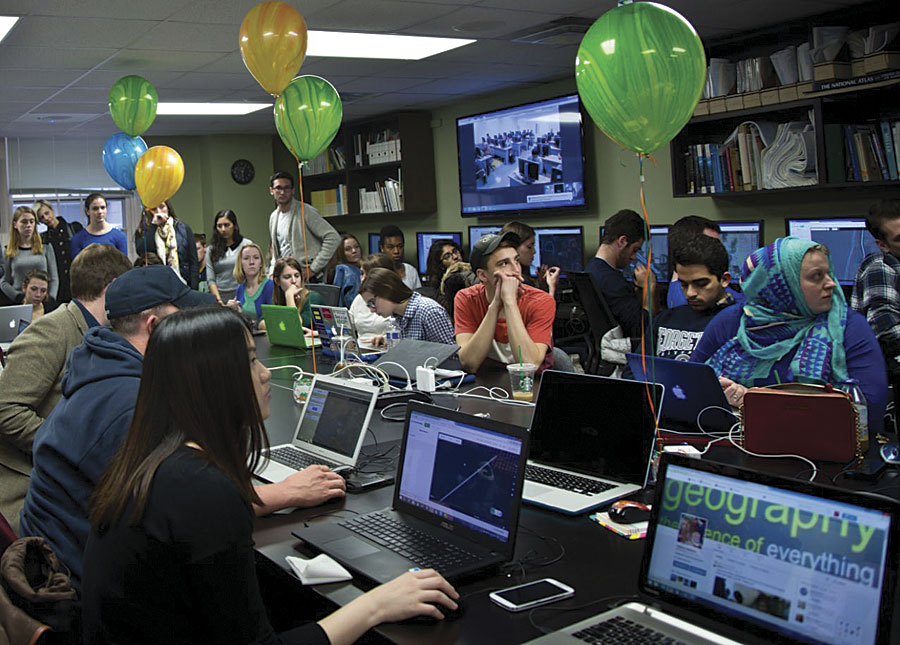
Youth Mappers in a chapter at Khulna University digitize field notes onto the map. They collaborated with two other chapters in the United States on this project. Photo/Chad Blevins

Youth Mappers in a chapter at Khulna University digitize field notes onto the map. They collaborated with two other chapters in the United States on this project. Photo/Chad Blevins

[Youth Mappers is a movement that is galvanizing university students to change the world for the better by mapping it. The fledgling network of university-based mapping chapters is creating maps that will help United States Agency for International Development (USAID) projects that focus on increasing food security; preventing diseases such as malaria; and responding to natural disasters in Asia, Africa, the Middle East, Eastern Europe, Latin America, and the Caribbean.]

Youth Mappers project director Patricia Solis at Texas Tech University calls it the Geospatial Revolution 2.0. “It’s more than a technical revolution—it’s something of a social revolution too,” said Solis. She described how students often pitch in and work on volunteered geographic information (VGI) projects aimed at helping developing countries respond to natural disasters or fight problems such as poverty, disease, and hunger. In the process, they learn about other places in the world and get the opportunity to connect to students from these areas.

Last year, a chapter at Khulna University in Bangladesh and chapters in the United States at George Washington University and Texas Tech University collaborated to make a basemap of a rural community near Khulna, Bangladesh, where the US government’s Feed the Future initiative operates. Once the basemap was finished, the Bangladeshi students visited the area to collect detailed information such as the locations of bodies of water where high-protein fish and prawns are farmed. As part of efforts to improve food security, the map will help USAID better understand who has access to enough nutritious food to live healthy lives.

George Washington University students worked on the same rural area near Khulna, Bangladesh. The map will be used to support the US government's Feed the Future initiative there. Photo/Heather BlevinsGeorge Washington University students worked on the same rural area near Khulna, Bangladesh. The map will be used to support the US government’s Feed the Future initiative there. Photo/Heather Blevins


Students in developing countries know their communities and the land surrounding them well. They can add important information and a local perspective to maps, according to Carrie Stokes, director of GeoCenter, a USAID resource for expanding and institutionalizing the use of geospatial tools and analysis. (See “Mapping a Better World” on this page.)

“Many people in poverty feel they don’t have a voice in their own governance,” she said. “Give them a skill to define their world by mapping it [and] they feel empowered.”

Youth Mappers was formed under the auspices of the new Mapping for Resilience University Consortium. Julia Kleine, the Youth Mappers chapter president at Texas Tech University, said the group has great potential to help people in developing nations because of its international inclusiveness. “Youth Mappers gives people the opportunity to collaborate with students and youth from all over the world, ultimately creating a strong network of leaders in developed and developing nations that can face world issues together and be equipped with the tools to do so,” she said.

Most of the students who are drawn to Youth Mappers are those who have a drive for change and desire to give back to the world, said Kleine. This includes members who are international students from developing nations who are studying in the United States. Their reasons for getting involved are personal. They have experienced firsthand the struggles in the developing world and the lack of access to geographic data.

“If you can visualize the problems and visualize the solutions [with maps], that can bring us together to address development issues,” said Solis, who is also a research associate professor of geography at Texas Tech University.

Universities in the United States and in countries where USAID works are welcome to join the consortium. Students worldwide can participate in Youth Mappers chapters, mapathons, and research fellowships to create geospatial data for USAID projects in parts of the world where few maps exist. USAID awarded a $1 million grant in 2015 to the consortium.

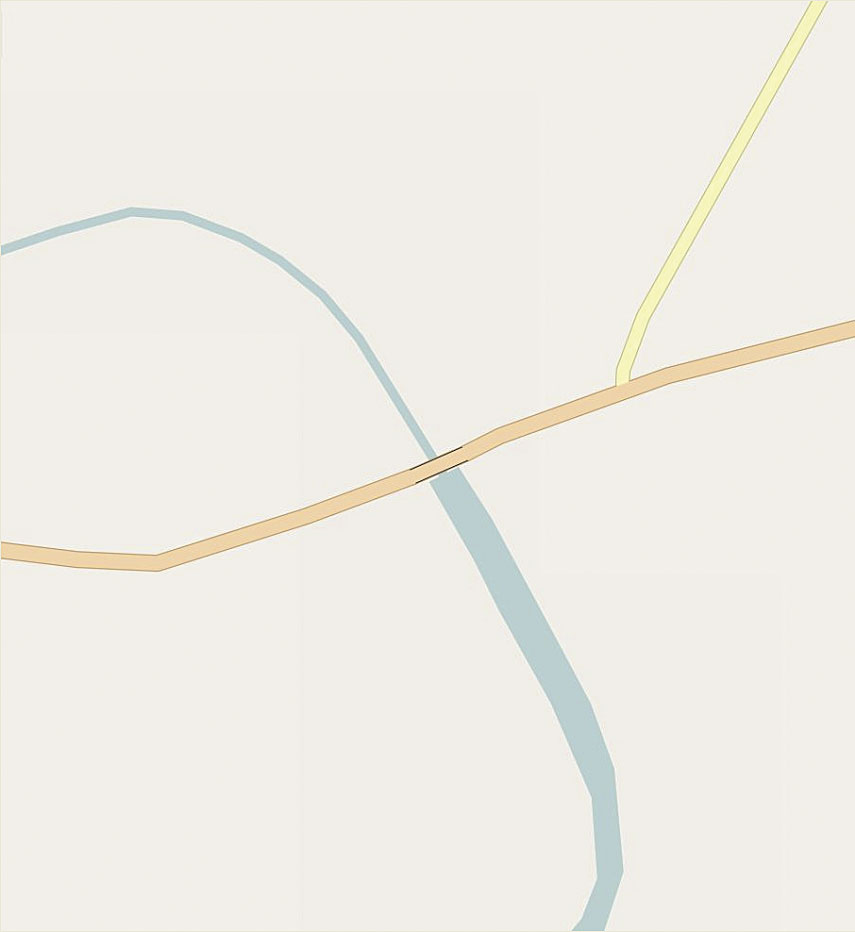
An OpenStreetMap basemap of a rural area of Khulna District in Bangladesh before detailed information was captured by local students. © OpenStreetMap contributors.

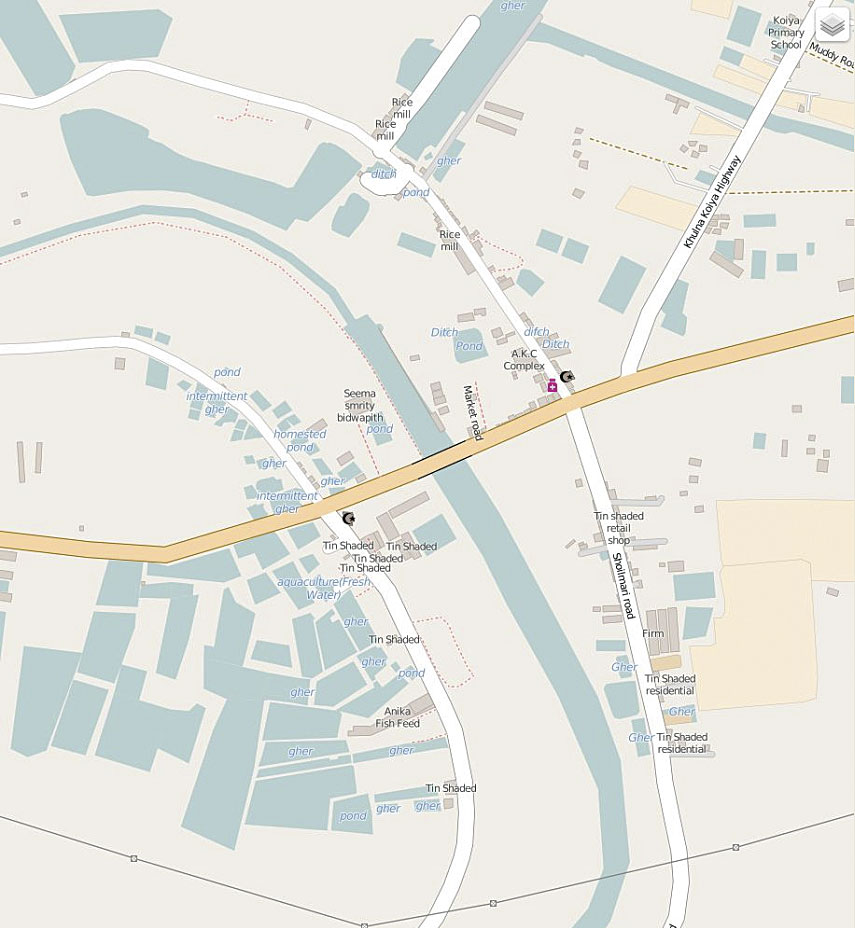
The same map after Khulna University students spent two days walking through this rural area of the Khulna District and added detailed information such as building types, the names of roads, and the location of fish ponds. © OpenStreetMap contributors

The GeoCenter works with the consortium’s founding members, Texas Tech University, George Washington University, and West Virginia University, to build what Stokes calls a “virtual partnership” between students in the United States and students in developing countries. The cadre of international student mappers will then collaborate on making maps using OpenStreetMap (OSM).

Students use high-resolution satellite imagery to map features such as roads, bodies of water, houses, and schools. Using OSM tools such as Field Papers or OpenMapKit, students who live in or near the cities or villages being mapped will go into the field to collect more detailed information to add to the maps, such as road names, the number of students at area schools, or the types of building materials used in houses. The information created by these projects is made available through OSM.

Texas Tech, George Washington University, and West Virginia University chapters have hosted several mapathons to build maps requested by USAID. The events, which offer free pizza and training, attract a diverse crowd that includes students from outside the GIS and geography realms.

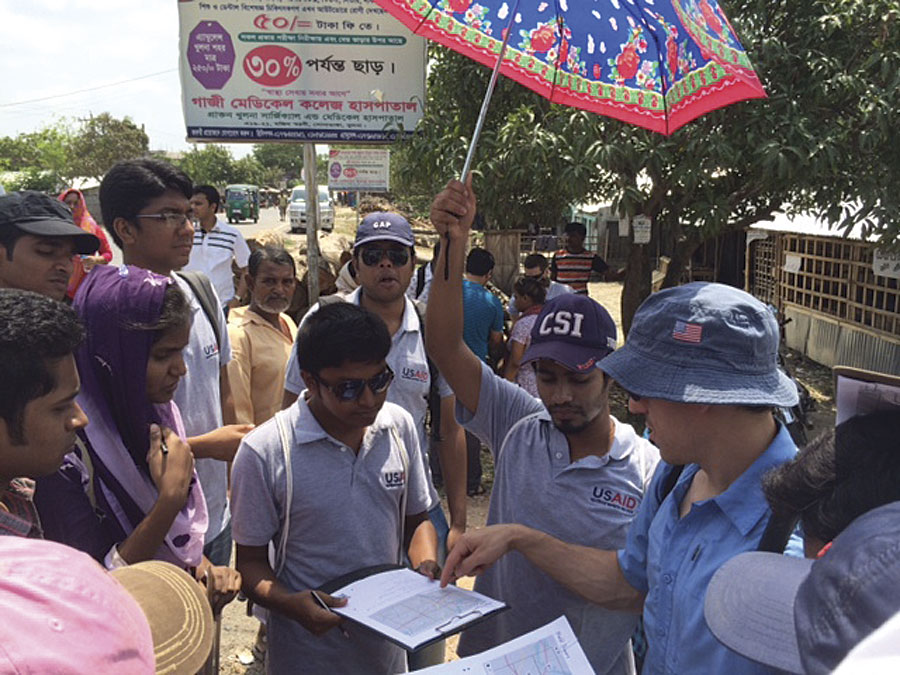
Chad Blevins from the USAID GeoCenter traveled to Bangladesh, where he provided instruction to Khulna University students as they prepared for a day of field mapping. 
Photo/Michael CrinoChad Blevins from the USAID GeoCenter traveled to Bangladesh, where he provided instruction to Khulna University students as they prepared for a day of field mapping. Photo/Michael Crino

In November 2015, these three chapters held a lively mapathon to create a basemap of the African seaport city of Quelimane, Mozambique. Using high-resolution imagery from USAID, the students competed to see which school could map the most features, including houses and roads. An estimated 26,000 buildings and more than 1,000 roads were put into OSM during that mapping effort. The map, now populated with roads and houses, will be used to plan an anti-malaria campaign there. It will help malaria prevention workers plan where and how much insecticide to spray. “If you short-change yourself by not having enough insecticide,” said Stokes, “it affects the efficacy of the entire effort.”

Stokes points to a successful collaboration in 2013 between students at George Washington University and students from Kathmandu Living Labs. The GeoCenter and the World Bank’s Disaster Risk Reduction team mapped the city of Kathmandu in earthquake-prone Nepal.

George Washington University used satellite imagery to trace roads, buildings, and other infrastructure. The map features were subsequently validated on the ground by Kathmandu Living Labs students who collected attribute data for those features.

Texas Tech University's Youth Mappers chapter president Julia Kleine helped create a map of the city of Quelimane, Mozambique.Texas Tech University’s Youth Mappers chapter president Julia Kleine helped create a map of the city of Quelimane, Mozambique.


When a magnitude 7.8 earthquake struck Nepal in April 2015, the George Washington University students enhanced the Nepal map on OSM, Stokes said. The GeoCenter downloaded the new map data onto GPS units that American search-and-rescue teams took to Kathmandu.

“It’s not just about tech. It’s really about making a difference in the world,” said Solis, who witnesses the enthusiasm among the students for these projects. “People care about people around the world when they know something about them,” she said.

And do they have fun? “We are talking about a gaming culture,” said Solis. “[Students] are motivated. They love the challenge of doing this. But most importantly, the learning potential for making real connections to other places and other students is profound. Youth Mappers not only builds maps, we also build mappers.”

Stokes knows that, in the years ahead, the work the GeoCenter does with the consortium to train and mentor the young mappers will be critically important. “We are not only creating the next generation of maps for USAID, but the next generation of mappers for the world,” she said.

For more information about the Mapping for Resilience University Consortium, contact mappers.vpr@ttu.edu. Get more information about the Youth Mappers chapters.

Citizen Scientists being Trained for Reef Monitoring in the US Virgin Islands

Crucians Trained to Monitor Reefs

Lisa Terry surveys a reef. (Photo by John Melendez)

Lisa Terry surveys a reef. (Photo by John Melendez)

About a dozen St. Croix residents learned Monday evening how to identify coral bleaching and other reef disturbances and how to scientifically report them for monitoring purposes.

Lisa Terry, science technician and dive safety officer for The Nature Conservancy, made the training presentation on what residents need to know to become what she called “citizen scientists.”

BleachWatch is sponsored by The Nature Conservancy and falls under the umbrella of its Reef Connect program. The Reef Connect website was revamped in March and includes everything about BleachWatch, including Terry’s training presentation.

She said she was pleased with the way Monday’s event went. “They asked very good questions and were excited. She added that everyone present took the underwater survey forms that the “citizen scientists” will need to fill out to be part of the program, she said.

For St. Croix residents who missed Monday’s training event, another will be held at 5:30 p.m. Tuesday at The Nature Conservancy in Little Princess. Residents of St. John and St. Thomas will get a presentation on BleachWatch Virgin Islands during the first part of the second week of September. Terry said September and October are the months when bleaching is most likely to occur.

In June the National Oceanic and Atmospheric Administration said a third consecutive year of higher-than-normal sea temperatures could lead to an increase in coral bleaching around the world and in the Virgin Islands.

According to Terry, high school interns performed surveys around St. Croix during July and reported no bleaching, but did find instances of coral disease. However, she indicated that a couple of reports of bleaching on deeper corals were received from volunteers who were trained in years past. Some scientists believe that deeper coral, being protected somewhat from the warming surface waters, are the key to coral reef survival.

Terry told the Source that divers at TNC have “noticed some paling in some of the deeper plate corals but haven’t seen any-wide spread bleaching this year.”

When asked what she hopes BleachWatch will accomplish, she explained, “Coral bleaching is largely due to warming waters from climate change and while we, on a local level, might not be able to stop climate change by ourselves, we can monitor and track these events as they happen to determine which reefs are more or less resilient to bleaching. Then we can use this knowledge to inform further conservation efforts, like the creation of protected areas or reducing pollution or overfishing in areas that are already susceptible to bleaching so as not to compound their stress.”

The survey sheet filled out by the citizen scientists is detailed and includes instructions such as “Estimate the percent coral coverage and other observations using the BleachWatch VI Data Sheet. Record any other findings (ex.: number and types of herbivorous fishes, number and types of invertebrates, number and types of diseases, etc.) using the notes section. Take photographs at each of your five survey stations and of any important observations or organisms.”

For residents who don’t want to get into such detail but would like to report reef damage, there is a quick report section on the BleachWatch page. When you get to the “quick report” feature, pin the map where you saw the disturbance and select from a list of disturbances, including coral disease, marine debris, and anchor damage.

“We hope that, if nothing more, the program encourages community members and visitors to pay attention to what’s happening on our reefs and inspire them to get involved with conservation efforts.”

Why Perceived Inequality Leads People to Resist Innovation

by Calestous Juma (bio here)                                      from the Washington Post, August 17, 2016
Americans are often portrayed as technological enthusiasts with unbounded eagerness to adopt new technologies. According to a recent Pew Research survey, nearly 28 percent of Americans view themselves as early adopters of new technologies. This is much higher than estimates in other cultures.

But when it comes to biomedical technologies that enhance human abilities, they are more cautious. Many of the 4,000 survey respondents and focus group participants in another Pew study “felt that while no effort should be spared to help the sick, society should proceed with caution before allowing biomedical advancements to boost the capacities of healthy people.”

On the surface it would appear that the concerns were about the desire to maintain human identity and nature as we have come to perceive them. However, there are deeper concerns about equity and social justice at work. As I argue in “Innovation and Its Enemies: Why People Resist New Technologies,” the fear of loss is a major driver of technological anxiety. This is more prevalent in societies where inequalities are already a manifest social feature.

Technological anxieties — as well as opportunities — are heightened by the dazzling rate of change we see today. Performance enhancement is a cornerstone of technological innovation, and up to now, it has predominantly applied to extra-bodily applications. A decade ago, technologies such as gene editing, brain implants and synthetic blood were confined to realms of basic research with distant applications. That is no longer the case.

As the Pew Research survey shows, there are always supplementary arguments against emerging technology. Certainly, brain implants have the potential to confer advantage to sections of society with access to them. But it also lends itself to criticism because of security concerns. The prospects of having those with brain implants hacked or remotely controlled are real. Such security concerns provide a convenient cover that allows equity and social justice issues to go unaddressed.

The rapid pace of change is likely to create anxiety among large sections of society. But its exponential nature will also dramatically increase technological possibilities available to humanity to address its challenges. The future therefore will be influenced by how well we can design social systems that allow humanity to harness the benefits of emerging technologies in inclusive ways. This is not pandering to socialist ideas but appeals to fundamental moral values that define who we are as humans.

Many of the emerging technologies are ready for commercial deployment faster than governments can figure out how to regulate them. In some cases governments are making early decisions not to regulate emerging technologies. For example, the U.S. Food and Drug Administration has announced that it will not regulate fitness trackers and wellness apps.

This hands-off approach is a signal that the government will not unduly stand in the way of innovation. But the public could construe such a decision as government abdication of its duty to regulate new technologies. This is problematic as people traditionally look to government to ensure that advancements in industry protect the public interest and promote social goals, such as equity.

Even better regulation may not address the deep-seated perceptions that new technologies could lead to inequities. The imagery of “superhumans” and human “robots” painted in the Pew Research survey reveals concerns about capability divides in society that give unnatural advantages to certain groups.

The way forward lies in bringing our fractured societies in line with human aspirations and technological possibilities. Much has been said about preparing future generations by strengthening their science, technology, engineering and math (STEM) education. This is only half the equation.

STEM education without deeper appreciation of what makes us human is futile. Many of the business models that glorify “disruption” seek to unravel the social tapestry that humanity has over time woven together around incumbent technologies. The rise of sharing businesses such as Uber, Lyft and Airbnb offers great benefits to consumers, for example, but their disruptive business models are generating disquiet in incumbent industries and changing our views of car- and homeownership.

Conversely, engaging in social and political discourse without an adequate understanding of the technology exposes our ignorance. We need a balance between the two. Rather than returning to the days of “natural philosophy,” education today requires a more enlightened approach that integrates the study of technology and the humanities.

The integrated education addresses this perception of inequity in two primary ways. It gives innovators greater awareness of how their inventions impact people at all levels of society, from those who adopt technology early to those who often get left behind. And those impacted by innovation are more likely to embrace new technologies when they are developed in an environment that is sympathetic to their social needs.

[Calestous Juma is a professor at the Kennedy School of Government at Harvard University and is a former director of the UN Convention on Biodiversity.]

from <https://www.washingtonpost.com/news/innovations/wp/2016/08/17/why-perceived-inequality-leads-people-to-resist-innovation/?wpisrc=nl_innov&wpmm=1#comments&gt;

A Chinese flagship Citizen Science/Crowdsourcing Initiative

[The Woodrow Wilson Center in the District of Columbia has a special program on Citizen Science initiatives (sign-up information at the bottom of this post). This message from the Center’s Elizabeth Tyson highlights a Chinese water quality monitoring program which has several elements that might be adapted for someplace in the insular Caribbean, and which could be considered for a NatureTech award.]

Hi All –

For those of you following the development of citizen science and crowdsourcing in the People’s Republic of China, here is a succinct update on theInstitute for Public and Environmental Affairs flagship citizen science river monitoring initiative, “Foul and Filthy Rivers.” The unique program leverages a mobile application (Blue Map) for citizens to report “odorous or filthy areas” of rivers. What happens next is quite unique in the citizen science and policy realm in that the information reported goes straight to the municipal environmental protection agency and they have 7 days to investigate and close the claim. After 7 days the report becomes public.

The following is an update on the initial metrics of the program. These were compiled and provided to me by Kate Logan, an employee of IPE. For further information you can follow the hyperlink to WeChat (social media application in China) and use google translate to get further information.

“August 9: How much progress has “black and smelly” rivers made? Organizations begin citizen surveys

    • Introduces the background of the government’s project and the coalition of environmetnal NGOs that are working to publicly supervise the initiative, inviting more volunteers and NGOs to join in their efforts
    • Guizhou is the only province where the number of �扈㈻� have actually decreased
    • Urges government to be more proactive in releasing results of cleanup efforts, and citizens to be active in supervising

August 10: Black and Smelly Rivers Investigation: Beijing, Jiangsu, and Fujian NGOs Get Started

    • Results of local NGO investigations in Beijing, Jiangsu and Fujian

August 12: Black and Smelly Rivers Investigation: Shandong, Henan, Hubei, Hunan and Guangdong NGOs Get Started

    • Results of local NGO investigations in Shandong, Henan, Hubei, Hunan and Guangdong

August 16: The Blue Map’s “Black and Smelly River Reporting Version” Goes Live! A New Way of Supervising Black and Smelly Rivers!

    • Infographic on how to use the Blue Map app to report
    • Can also now use the Blue Map app to see where reports have been made
    • Already 50 individual reports have been officially accepted

August 17: Black and Smelly Rivers Investigation: I’ve Reported a Black and Smelly River, Will I Get a Response?

    • Of 1846 reports from February 18 through the end of July, 1727 had been “resolved,” a rate of 94%
    • The highest number of reports came from Beijing (576), followed by Hunan (302), Guangdong (164) and Shandong (137)
    • A handful of provinces did not respond within the deadline of 7 days, with Liaoning not having a single instance of responding on time any of the ten complaints raised. Conversely, Beijing had a 100% rate of responding on time.
    • Complaints peaked on March 14 to 20, coinciding with World Water Day
    • The potential effect of grassroots NGOs can be seen in that there were a high number of reports in provinces with high environmental NGO activity — and in particular Hunan, where the number of waters designated for cleanup is relatively high, likely due to the active work of citizen reports. However, there are still some provinces with a discrepancy between the high number of reports and low number of waters designated for cleanup, which must be further examined and addressed”

Cheers and Happy Summer,

Elizabeth Tyson Elizabeth.Tyson@wilsoncenter.org
CoDirector, Commons Lab, Wilson Center

Message via CitSci-discussion-L@cornell.eduthe discussion-based listserv for the community supporting citizen science, volunteer monitoring, and other forms of public participation in scientific research.

To subscribe or unsubscribe, visit http://www.citizenscience.org/elist/
With questions about this listserv, email us at info@citizenscienceassociation.org

Markets for Good Launches Good Data Grants


FOR IMMEDIATE RELEASE
July 27, 2016

CONTACT
Erin Fogg 831-515-6403
erin@spokeconsulting.com

Markets for Good Launches Good Data Grants for a Higher Impact Social Sector

New grants program from Stanford PACS will fund research and innovation to help the social sector use data safely, ethically, and effectively to improve its work.

STANFORD, CA – Markets for Good (MFG), an initiative of the Stanford Center on Philanthropy and Civil Society (Stanford PACS), announced today that it is launching a new national grant opportunity, Good Data Grants.

With the support of the Bill & Melinda Gates Foundation, the Good Data Grants program will focus on the role of digital data and infrastructure to improve decision-making in philanthropy (particularly individual giving) and in the social sector writ large.

Grants will be awarded for two types of projects: scholarly research and practical innovations. The program aims to support research, prototypes, and shared learning that can help donors and social sector organizations use digital data safely, ethically, and effectively to improve their work.

Lucy Bernholz, Senior Research Scholar at Stanford PACS and Director of its Digital Civil Society Lab, said of the new program: “We’re excited to support new ideas and innovations that will help nonprofits and donors boost their impact through the responsible and effective use of digital data. We’ll draw on the resources and expertise of the MFG and Digital Civil Society Lab communities to support grantees and help them share their work for the benefit of the entire social sector.”

The launch of the Good Data Grants program marks the first year of a planned three-year grants program. For its first year, Markets for Good will select 5 to 15 grantees to receive funding from a pool of $200,000. The deadline for proposals is September 30, 2016, and grants will be announced and awarded in November 2016.

Markets for Good will host three live webinars to discuss the grants program in detail and respond to questions from potential applicants (click below to RSVP):

Grantees will be invited to the Do Good Data conference at Stanford in February 2017 and will present the outcomes of their work to the MFG community in the fall of 2017.

Good Data Grants are intended to support researchers and innovators in developing new learning and tools that the entire social sector can use to improve the safe, ethical, and effective use of data in the digital age. All work supported by Good Data grants will be publicly shared and geared toward improving practice in the field.

To learn more, view the full Request for Proposal.

For more information, please visit www.marketsforgood.org.

###

ABOUT MARKETS FOR GOOD
Markets for Good (MFG) improves the data infrastructure for social good. We share ideas and support innovation to advance the safe, ethical, and effective use of digital data for a higher impact social sector. MFG facilitates the online exchange of expert and practical data-related knowledge through a robust online community, and we foster innovation and original research with grants and mentorship. We also host in-person events that foster knowledge sharing and ideation for the community, as well as cross-sector information sharing between public and private sector partners, and research on emerging relevant issues.

To learn more or schedule interviews, contact Erin Fogg at 831-515-6403 or visit marketsforgood.org.

ABOUT THE STANFORD CENTER ON PHILANTHROPY AND CIVIL SOCIETY
The Stanford Center on Philanthropy and Civil Society (Stanford PACS) is a research center where scholars, practitioners, and leaders come together to explore ideas for social change. Stanford PACS publishes the preeminent Stanford Social Innovation Review (SSIR). This interdisciplinary center works with 5 schools, 20 departments, and 100 faculty affiliates to catalyze innovative research and explore new ideas to improve philanthropy and strengthen civil society.

To learn more or schedule interviews, contact Erin Fogg at 831-515-6403 or visit pacscenter.stanford.edu.

Copyright © 2016 Spoke PR, All rights reserved.